Time is the
mechanic,
not the theme.
A real time card game for two, built on your world and your rules, with one component doing the work that priority and energy crystals do on a screen.
For Jason · from Zack Howe & Cole Beardsley at Pamplemoose Games
Your game is about time.
So this one runs in
real time.
Every CCG ever built takes turns. Magic, Hearthstone, Runeterra, Chrono. The category is turn based because software has to ration action somehow, and priority is how you do that on a screen.
A slanted liquid tube with a rising bubble rations it instead, and it pays you while it climbs. Nobody has used a timer as a resource generator, and for a game whose entire fiction is the timestream, that component was always yours.
Thirty seconds. Ten gates.
Four slots.
Two players, about five minutes. A run is one traverse of the bubble. A game is three to five runs. There are no turns and nobody ever waits.
Both players draw three. The bubble releases and the tide climbs, one gate every three seconds.
Play any card the tide has reached, or discard it to dig faster. Empty your hand to draw three more.
Cards land live and stay. Four slots a side, column against column.
The bubble slides under a hood and vanishes. Time is up. Anything still in your hand never existed.
Columns strike at once. Damage hits Cores. Flip the tube and the next run begins.
The Tide
Nothing is ever spent. The gate the bubble has passed is your energy, and it only rises. A card's cost is the earliest moment it becomes legal to play.
No counting, no tokens, no arithmetic while two people are reaching for the table at once. You both read the same number off the same object.
The Hold
You are never forced to empty your hand. Keep a card the tide has not reached and you draw nothing until you let it go. That is the price, and it is brutal.
Nothing is ever dead
Because the tide only rises, every card becomes playable eventually. Draw an 8 at second three and you can still play it at second twenty-four. The question is what you gave up waiting for it.
Every second you freeze
Holding costs you draws, repositions, and every cheap card you would have found in the meantime. Sometimes it is still obviously correct. That tension is the game.
Gate 9 lands at second twenty-seven, so nobody draws into a 9 and plays it. They sit on it. Your top end becomes cards you build a run around, which means a list should carry very few.
The clock is a free app.
And it
dings at every gate.
A phone flat on the table runs the thirty seconds and sounds a tone as each gate passes. That is the whole app at its core, and it is the single best thing in this design.
Eyes stay on the board
In a real time game your attention belongs on the cards and on what your opponent is landing. A tone at every gate means you track the tide without looking at anything, and blind and low vision players get the same game rather than an accommodation.
The collection lives here
The same app is where physical cards become digital ones. Scan, redeem, and it lands in the Chrono account the player already has. One install does both jobs, which is why the timer being free and unlocked matters so much.
Their Chrono login
The timer opens and runs with no login at all, because a sign-in wall at the moment two people sit down to play is friction in the worst place. Redemption signs into the Chrono account they already have, and for anyone who does not have one yet, creating it is the whole point. The box becomes an acquisition channel that drops people into your client with cards already in it.
Columns strike
simultaneously.
No attack token, no declared blockers, no priority. Your slot one faces their slot one. When the bubble hoods, every column resolves at once using Strength and Durability, and a filled slot facing an empty one hits the Core instead.
Nothing to adjudicate
Trades are genuine trades because damage lands in the same instant. Survivors reset to full Durability on the flip, so there are zero damage tokens on the table and nothing to track between runs except two Core dials.
One slide per cycle
Once per hand you may slide an Agent one slot sideways into an empty space. A column you set up at gate 2 can be dismantled at gate 7 by someone sliding out of it. Fill all four slots and you have nowhere to move.
Repositioning refreshes per cycle, so the player digging hardest gets the most of them. Cycling fast buys mobility, which pulls against ascension rewarding you for standing still.
Immortalization
becomes a choice.
Yours is condition triggered. Mine is a decision, and it turned into the strategic spine of the whole thing.
Outside the deck
Immortal forms sit face up beside the board, so they are never a dead draw. Your chase cards are on the table all game where both players can see them.
Stack, no slot
Stack the Immortal onto its base in the same slot. Free at tide, no card from hand, but never in the same gate window the base landed.
Hoarding punishes itself
An Immortal needs its base already standing, so the player who digs all run and dumps four fat cards at the hood has locked himself out of his own best cards.
The Immortal wears a richer frame and the same face, so the upgrade is legible across the table at speed. One card, one ascension. Transforming every copy is a database operation and it does not survive contact with a table.
Timelines become
cards in the deck.
The stack survives exactly as it is in your client. New on top, only the top one active, either player can shift. What changed is that they are drawn, and there are two slots.
Legality is shared
One slot per player, flanking the hood. Both open their Syndicates to both players, so a full choke needs both slots and the answer to being locked is to take the other one. Off-Timeline Syndicate cards cannot be played at all.
One card, two effects
A Timeline's Syndicate unlocks for both players no matter whose slot it sits in. Its buff or debuff touches only the row it is on. That split is the entire decision: put The Long Noon on your own side to pump your Agents, or drop The Quiet Hour on theirs to weaken them, and either way you have opened that Syndicate for both of you.
A Timeline is your cycle
Play one and it is the only card you play that cycle. The other two are discarded. That single rule killed the separate shift cost and the rate limit, because your deck list is the rate limit now.
So placing a Timeline is always a trade. You are handing your opponent access to a Syndicate in exchange for pointing a stat swing at one row, and that is why moving a stack across is a real answer even when destroying it is not. Landscape shape means you can tell what kind of card just hit from across the table, and the cradle slot can be cut so only a Timeline fits. Most of the pool is neutral, so a lockout bites payoffs and leaves you an engine.
Pay slots for access
Two Timelines in forty cards means you will play runs where one never shows up, and thirty seconds is no time to dig. Tutors fix that the way deckbuilding should: two Timelines plus three searchers is five of your forty, which is a real slot cost for reliable access.
Nobody rifles a deck
Searching forty cards while a bubble climbs is impossible, and your opponent is still playing while you do it. So a tutor either resolves at the flip, in the untimed beat between runs, or it peeks a fixed three off the top and bottoms the rest.
Three types, three shapes
Thirty seconds,
played out loud.
B spent eighteen of thirty seconds unable to draw a card. She got her 6 down. Whether that was worth it is the whole game.
Everyone gets the app.
Some people buy the
artifact.
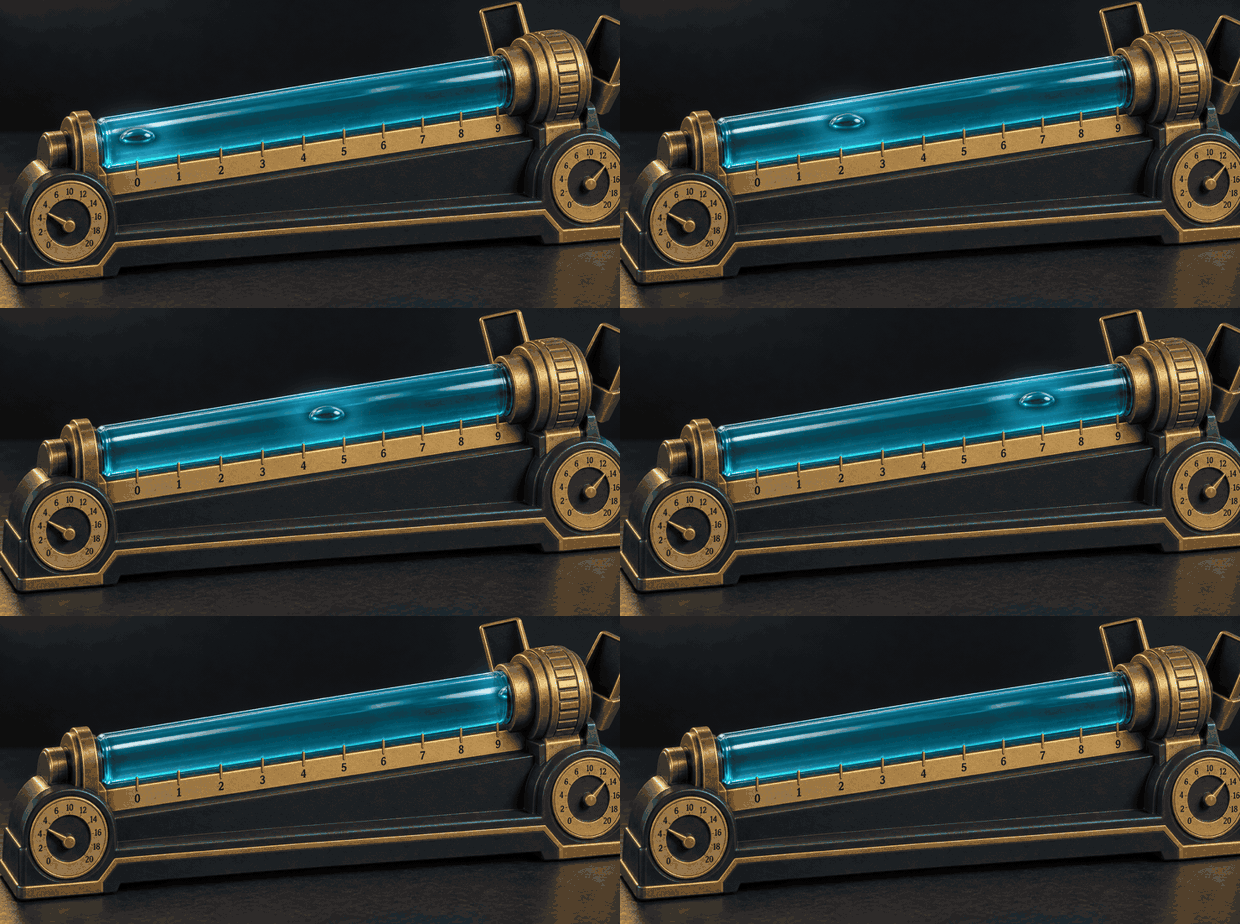
Here is the tide as a physical object. A slanted liquid tube in a weighted cradle, gates 0 through 9 printed along a brass rail, an opaque hood at the high end, and a Core dial at each end. The app calls the gates out loud. The tube is what everyone at the table watches.
Optional on purpose
Nobody has to buy a tube to play, which is exactly why they will. Card games already sell premium dice and playmats to people whose cardboard ones work fine. None of those objects sits in the middle of the table and moves while both players watch it. Colorways per Syndicate, machined metal, glass, numbered editions.
Add-ons lift the average
An add-on raises what a backer spends without raising the funding goal you have to clear, and it sells to somebody who has already decided to trust you. It is also the shot the campaign video is built around, because a real object moving on a table is the only thing in this whole product that photographs itself.
Make the code
its own rarity.
You wanted QR codes on cards redeeming for digital ones, with rarer connections granting real Chrono cards. That works, and it is worth more than a redemption scheme, because the code can be a chase axis all by itself.
Sealed code card
One per pack, guaranteed, grants a digital pack. The floor never depends on which cards you pulled, so nobody feels cheated by a bad box.
Marked cards
A visible glyph in the frame grants a cosmetic. To anyone not looking for it, it reads as ornament.
Hidden in the art
A glyph worked into the illustration itself, granting a real Chrono card. Opening a pack becomes a hunt.
The reason this beats a flat redemption scheme is that it puts the chase somewhere other than card power. Collectors hunt codes, players hunt playables, and the two markets stop competing for the same cards. A weak common can be the most wanted card in the set without touching balance.
Let's make
this thing.
Tell me what you think. If it has legs, I would love to build it with you.
zack@pamplemoosegames.com
Concept prepared by Pamplemoose Games LLC for Infinite or Bust Games Inc. All Chrono CCG brand assets, names, and imagery appear solely to illustrate this concept and remain the property of their owners. Game mechanics and designs in this document are original work of Pamplemoose Games LLC. AI never touches the game design. Not for distribution.